Signs of water damage in a ceiling, and what each one means
A brown ring, a sag, a hairline crack and a cold patch are four different problems wearing similar clothes. The useful skill is telling a live leak from one that finished months ago.
Published
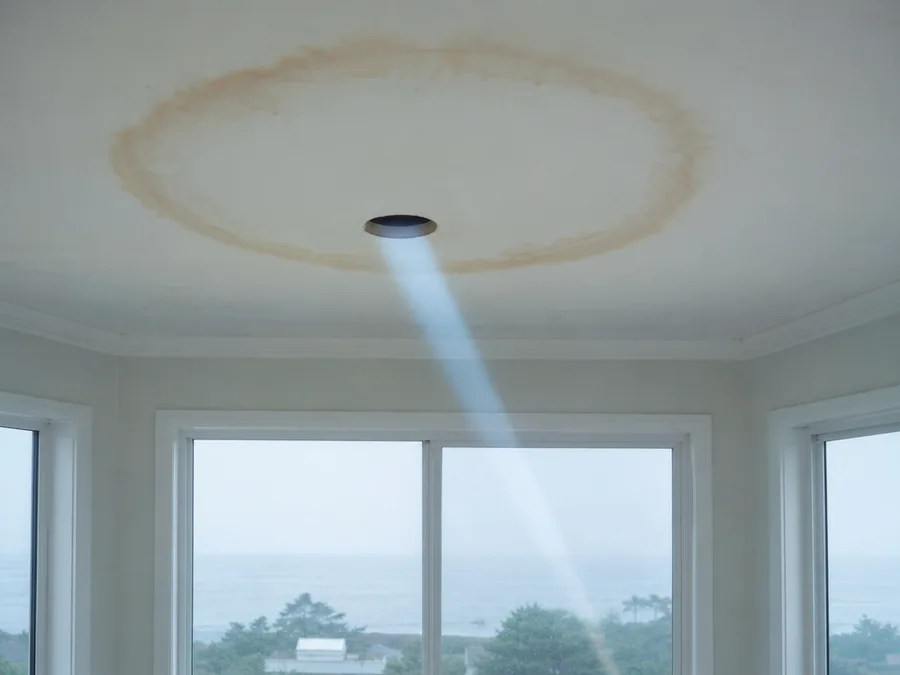
Start with one question: is it still happening?
Every mark on a ceiling falls into one of two categories, and almost nothing else about it matters until you know which. Either water is still arriving, or it arrived once and stopped.
The tests are simple and worth doing before anyone opens anything.
Draw round it. Pencil, faint, on the edge of the stain, and write the date next to it. Come back after the next wet day or after the next time an upstairs bathroom is used heavily. A mark that has grown past the line is live. A mark that has not moved in a fortnight of normal use is probably finished, though that is not the same as harmless.
Touch it, lightly. A live area is often cooler than the ceiling around it, because evaporation takes heat. Soft, spongy or yielding means the board itself has lost strength and is now a structural question rather than a cosmetic one.
Look at the edge. A sharp, well-defined brown ring with a clean outer edge is usually an old mark that dried and stopped. A diffuse edge that fades outward, or a series of concentric rings, means repeated wetting over time.
What each sign actually tells you
A brown or yellow ring. The classic. The colour is not mould, it is dissolved material carried out of whatever the water passed through: adhesive, timber tannin, old plaster, dust in the void. Its shape is a map of where the water pooled on top of the board, and the lowest point of the ring is usually the closest thing to directly below the source.
A sag or a bulge. Water is being held above the board, or the board has absorbed enough to lose rigidity. This is the one sign on the list that is genuinely urgent, because a saturated plasterboard ceiling that lets go does so all at once and it is heavy.
Bubbling or flaking paint. Moisture has come through from behind and lifted the coating off the substrate. It means the board got wet from above rather than being splashed from below, which rules out most innocent explanations.
Fine cracking in a line. Often movement rather than water. If it follows a joint or a board edge it is more likely to be a taping or seasonal movement issue. Water-related cracking tends not to run straight.
A musty smell with no visible mark. The most under-read sign of the set. The CDC's own description is that mould grows where there is moisture such as around leaks in roofs, windows or pipes, and that it grows on paper, cardboard, ceiling tiles and wood, which is a fair description of the inside of a ceiling void. Smell without a stain generally means the wet area has not yet reached the visible face of the board.
Rust or staining on a light fitting. Water finds the hole. A ceiling penetration is the low point of the assembly and will often show a problem before the board does, and it puts water where the wiring is.
Where it comes from, ranked by how often it is actually the cause
Most people's first guess is the roof. Most of the time it is not.
- A bathroom directly above. Failed sealant around a shower tray, a leaking waste connection, a basin trap, or a floor that lets water past at the perimeter. The give-away is a stain that moves after use rather than after weather.
- A supply line inside the floor assembly. Consistent, unrelated to weather or use, often growing steadily.
- The roof. Correlates with rain, and usually with wind direction as much as rainfall. A roof leak that only appears in driving rain from one direction is common and is why some leaks seem to skip storms.
- Condensation. Not a leak at all. Warm moist air meeting a cold surface, most often on the underside of an uninsulated section. It shows as a general dampness or spotting over an area rather than a defined ring.
- An appliance. A washing machine, a dishwasher or a water heater on an upper floor.
Timing separates these more reliably than location does. Weather-linked points at the building envelope; use-linked points at plumbing; constant points at a supply line; and cold-weather-only points at condensation.
Why opening it is usually the right move
There is a strong instinct to avoid cutting into a ceiling, and it is usually the wrong instinct. A small inspection hole at the lowest point of the stain does three things at once: it tells you whether the void is currently wet, it lets you see the source directly, and it releases any water being held above the board before it finds its own way out.
It is also the difference between drying the ceiling and drying the room. A closed void has almost no air movement in it, so it dries far more slowly than the room below, which is exactly how a ceiling comes back to look perfect and then stains again a month later. What the repair actually involves, in order, is on our page for ceiling water damage repair, which treats a stain as a drying problem with a source to find rather than as a patching job.
The part that decides the cost: how long it ran
Everything above is diagnosis. The number that decides the size of the job is duration.
A leak found in the first day is a drying job. A leak that ran for weeks behind a closed ceiling has been feeding the void the whole time, and the EPA's 24 to 48 hour window for preventing mould growth passed long before the stain appeared on the face of the board. At that point the ceiling is a symptom and the scope includes whatever grew above it, which our page on mold remediation covers.
Two EPA details matter here specifically. The first is that ceiling tiles are named among the absorbent or porous materials that may have to be thrown away once mould grows into them, because it fills the spaces inside the material rather than sitting on the surface. The second is the rough threshold: about 10 square feet, roughly a three foot by three foot patch, above which householders are pointed at professional remediation guidance rather than doing it themselves. A ceiling void is very good at exceeding that quietly, because nothing about the visible stain tells you how far the wet area extends above it.
And if the water arrived from an upper floor as a one-off failure rather than a slow leak, the first forty-eight hours matter for the whole building and not only the ceiling. That sequence is in our guide to what to do after water damage.
What this site does
We arrange the work rather than doing it. What you send goes to a restoration company operating in the East Bay, on the same basis as the main water damage page. We do not employ the people who attend, so we do not describe their credentials, and we do not publish a time by which anyone will be there.
For a ceiling, a photograph is worth more than a paragraph. The address, a picture of the mark, and whether it changes after rain or after someone showers upstairs are usually enough for somebody to say what they are looking at.
Where the guidance on this page comes from
Each row was read on the publisher own page on the date shown.
| Publisher | What it says | Read |
|---|---|---|
| US CDC, mold basics | Mold will grow where there is moisture, such as around leaks in roofs, windows or pipes, or where there has been a flood, and it grows on paper, cardboard, ceiling tiles and wood. | 2026-08-31 |
| US EPA, A Brief Guide to Mold, Moisture and Your Home | It is important to dry water-damaged areas and items within 24 to 48 hours to prevent mold growth. | 2026-08-31 |
| US EPA, Mold Cleanup in Your Home | Names ceiling tiles specifically among the absorbent or porous materials that may have to be thrown away if they become moldy. | 2026-08-31 |
| US EPA, Mold Cleanup in Your Home | Sets a rough threshold of about 10 square feet, roughly a 3 foot by 3 foot patch, above which householders are pointed at professional remediation guidance rather than doing the work themselves. | 2026-08-31 |
Ceiling questions, answered
-
How long does it take for a water damaged ceiling to dry out?
The surface can look dry in a day while the cavity above it is still wet, which is the trap. What matters is the material reading dry rather than feeling dry, and a closed ceiling void dries slowly because there is very little air movement in it. The EPA window for preventing mold growth is 24 to 48 hours from when the material got wet, which is usually well before anyone noticed the stain. -
Can you live with water damage in the ceiling?
With a small old stain from a leak that is genuinely finished, usually yes, and plenty of houses do. What you cannot safely ignore is a ceiling that is sagging, one that is soft to touch, or one where the mark is still growing, because those indicate weight being held above a surface that was never designed to hold it. The CDC also lists ceiling tiles among the materials mold grows on directly. -
Is water damage to the ceiling covered by insurance?
It usually turns on what caused it rather than on the damage itself. A sudden failure, a burst supply line or an appliance that let go, is treated differently from a slow leak that had been running for months, and from maintenance issues like a worn roof covering. That distinction is where most disputes sit, and our page on California water damage claims goes through the language in detail. -
Can a water damaged ceiling be fixed?
Almost always, but the repair is the last step rather than the first. The source has to be found and stopped, the cavity above has to be dried and checked, and any material that absorbed water and cannot be dried in place has to come out. Painting over a stain before those three things are done buys a few weeks and hides the evidence that would have made the diagnosis easy.
Send a photograph of the ceiling
The address and a picture of the mark are usually enough for a restoration company to say what it is looking at.