Water damage restoration in Alameda, CA
On an island, the question is not only where the water came from. It is where it is allowed to go afterwards. Send us the details and a local restoration company takes it from there.
An island changes the second half of the job
Most water damage advice stops at getting the water out of the building. On Alameda that is roughly where the interesting part starts, because the island drains to the estuary, the lagoons and the Bay, and there is no long inland run to dilute anything along the way. Whatever goes into a gutter here arrives somewhere close and somewhere that matters.
The City is explicit about it. Alameda's Clean Water Program describes discharge of pollutants into the storm drain system as the leading source of water pollution in local creeks and San Francisco Bay, and it prohibits putting any non stormwater material into the storm drainage conveyance system. That prohibition covers the storm drains, the streets, the curbs and the gutters, and it is enforced under Alameda Municipal Code Chapter 18, Article 3 as well as under the regional stormwater permit.
Why that is a legal question and not a tidiness one
Read the City list of examples and one entry stands out for anyone who has had a floor flooded. Among the things it names as illegal to send down a storm drain is washwater from floors and from carpet cleaning.
That is exactly what comes out of a wet building. Extraction water off a soaked carpet, the discharge from a wet vacuum, the rinse from cleaning a hard floor: on paper these are ordinary parts of a restoration job, and on Alameda they cannot simply be pushed out of the door and into the street. They have to go to sanitary sewer through an approved connection instead.
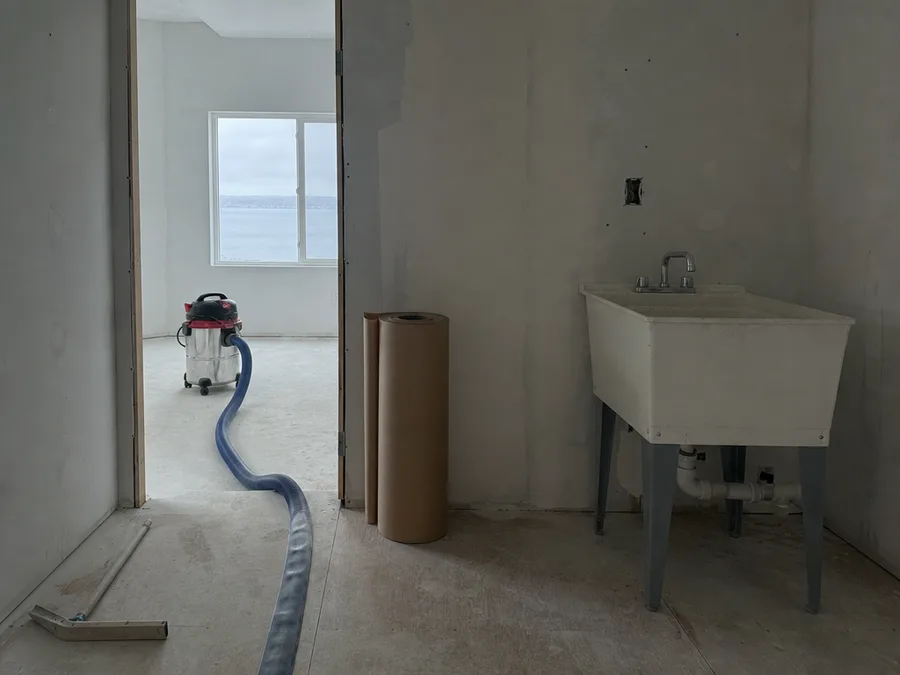
Practically, that means a competent job here arrives set up for it. A discharge hose run to a utility sink or a proper connection is not fussiness, it is what the code requires, and it is worth asking about before work starts rather than after somebody photographs a hose emptying into a gutter. A contractor who has worked the island will already know. One who has not may need telling.
The City also takes reports. Its Clean Water Program keeps a route for spills and for material already discharging into a storm drain inlet, the estuary channel, a lagoon or the Bay, and it sends non emergency reports through the City own online reporting system. That is worth knowing in both directions. It is how a neighbour reports a hose emptying into a gutter, and it is also the route to use if something at your own address reached the drain before anyone got there.
What tends to fail on Alameda properties
Low, flat ground behaves differently from the graded lots across the estuary. Water that gets into a building on level ground spreads rather than travelling, so the wet area is wide and shallow and it reaches more material than the same volume would on a slope. That usually means more square footage of flooring affected, and it means the perimeter, where water wicks into skirting and into the base of the wall, matters more than the middle of the room.
Standing water that came from a drain rather than from a supply line is a different scope entirely, and it is treated as category 3 sewage cleanup rather than as a wet floor.
Where water has sat, the question stops being about the water and starts being about what grew. Growth follows sustained moisture, and once material has stayed damp the scope picks up mold remediation work, with containment so that the cleanup does not distribute what it is removing.
Above your head, and after a fire
Water arriving from above leaves the same evidence everywhere, and a stained or sagging ceiling is treated as a drying problem with a source to find, not as a decorating problem. Cutting the lowest point of the stain to see what the cavity holds is the normal first move.
The aftermath of a fire is usually also a water problem, because a great deal of water goes into a structure to put one out. Soot, odour and saturated material get handled together under smoke and soot restoration.
What we do, said plainly
This site is not a restoration company. It takes the details of a loss and passes them to one that works in the East Bay, and the same arrangement is set out on what this site does across the East Bay. We do not employ the people who turn up, so we do not describe them with words we cannot stand behind, and we do not publish a time by which anybody will arrive.
What is worth putting in the message is the address, the room, what the water came out of, and roughly how long it has been there. Whether the water was clean, grey or from a drain is the single detail that most changes a quote, because it changes what has to be removed rather than dried. The full list of restoration jobs is on this site.
Elsewhere in the East Bay
Alameda is one of three towns with its own page here. Berkeley has a different problem, since it is graded and water there travels downhill inside the structure, and Piedmont is a separate city that runs its own sanitary and storm sewers.
Sources for the Alameda detail above
Read on the publisher own site on the date given. Nothing here is paraphrased from a summary.
| Publisher | What it says | Read |
|---|---|---|
| City of Alameda, Clean Water Program | Dumping any non stormwater material into the City storm drainage conveyance system, including storm drains, streets, curbs and gutters, is illegal. Its own list of examples names washwater from floors and from carpet cleaning. | 2026-08-31 |
| City of Alameda, Clean Water Program | Enforced under Alameda Municipal Code Chapter 18, Article 3, and under the Municipal Regional Stormwater Permit issued through the NPDES. | 2026-08-31 |
| City of Alameda, Clean Water Program | Describes discharge of pollutants to the storm drain system as the leading source of water pollution in local creeks and San Francisco Bay. | 2026-08-31 |
What Alameda owners run into
-
Can water pulled out of my floor go into the street drain?
No. Alameda prohibits putting non stormwater material into the storm drains, streets, curbs and gutters, and the City own list of examples names washwater from floors and carpet cleaning. It has to go to sanitary sewer through an approved connection. -
Does that slow the work down?
Not if the contractor arrives set up for it. It is a hose run and a connection rather than a different method. It is worth confirming before work starts. -
The water was clean when it started. Is it still clean now?
Not necessarily. Clean water that has run through building material, or sat for a while, is usually reclassified. What it touched and how long it sat matter more than what came out of the pipe.
Send the details of your Alameda water loss
One short form. It reaches a restoration company that works this side of the estuary.